Products
For Household Farming
Care
-
- Access to the farm is restricted. Entry for unauthorized persons and vehicles not involved in farm operations is prohibited.
- Animals may be introduced only from suppliers that provide laboratory confirmation of herd health status for diseases listed in current legislation.
- Animals selected for purchase must complete a 30-day quarantine at the farm of origin and again after arrival at the receiving farm. All transported animals must be identified in accordance with legal requirements.
- Upon arrival at the destination farm, each animal must undergo a clinical examination before or during unloading.
- During the preventive quarantine period, pigs are inspected daily. Selective temperature checks are carried out, and vaccination may be applied when necessary. Pigs may join the main herd only after the quarantine period is completed.
- Feeding pigs with feed containing ingredients from animals of the same species is prohibited.
- Water supplied to pigs must meet drinking water standards defined by legislation. Water from open sources must not be used. Feed should be purchased only from verified suppliers that follow safety standards. Feed must also undergo regular testing for quality and safety. Thermal processing of feed is required, while processing temperature and time should be determined based on risk assessment and scientific evidence.
- Incoming materials such as equipment and veterinary products may enter the farm and production buildings only after sanitation procedures. These include removal of transport packaging and disinfection using an appropriate method.
- Bedding must ensure cleanliness and comfort and must not contain pathogens that could cause infection. Bedding should come from a production system unrelated to pig farming and must not include pig production by-products. Bedding must be disinfected before use.
- In case of mortality, carcasses must be transported using designated containers and vehicles that prevent leakage of biological material and allow easy disinfection. Vehicles used for carcass transport must serve only this purpose and must be washed and disinfected after each use. Burial sites for animal carcasses, especially communal ones, must not be used for disposal.
- Manure must be stored in manure collection tanks located in the farm’s dirty zone, separated from the clean area and fenced to prevent unauthorized access. Vehicles used to transport manure must never enter the clean zone.
- Household and farm waste must be removed regularly.
- Production buildings must prevent entry of birds and wild animals and must have restricted access for people. Regular monitoring for rodents must also be carried out.
-
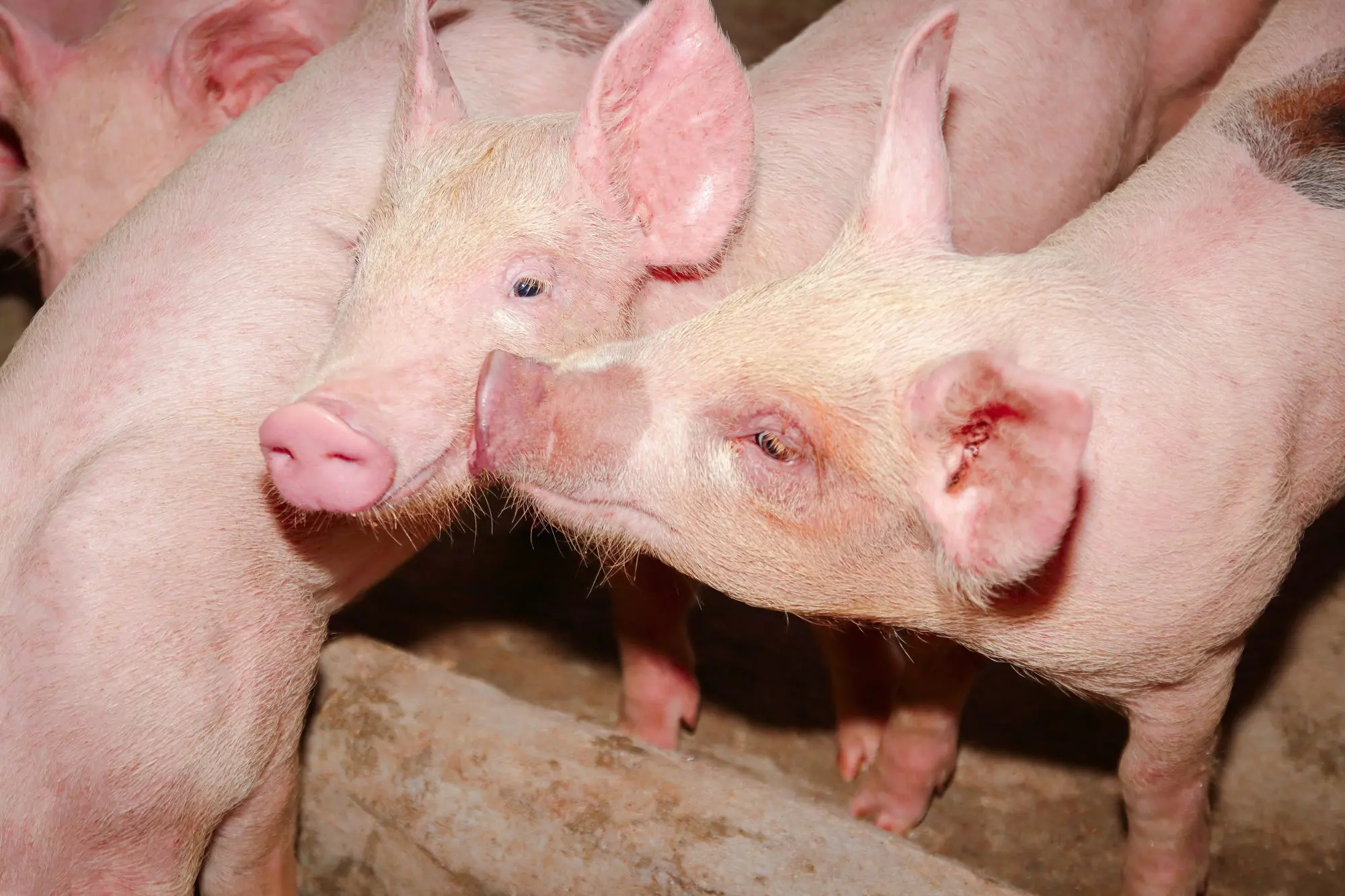
Preference should be given to piglets with a long body, a wide and deep chest, and elastic skin. In meat-type breeds, the tail must form a tight spiral, which indicates good muscle development throughout the body. Eyes should be clean and free from discharge or injury. There should be no swelling of the eyelids, and the look should be clear and lively. In a healthy piglet the head has proportional length. Good piglets are vigorous and mobile. We recommend using young animals from modern genetic lines.
-
Preparation of the building begins after piglets are removed. Remaining feed and bedding are cleared first. Mechanical cleaning follows to remove manure and dirt from pens, floors, feeders, drinkers, windows, doors, corridors, auxiliary rooms, and the outdoor yard. Surfaces are then washed with hot water until their natural structure and colour become visible. If necessary, routine repairs of the building and equipment are carried out. The floor is washed again after repairs.
Disinfection is performed using hot disinfectant solutions in doses recommended by the manufacturer. Buildings are disinfected either before the start or after the completion of a production cycle.
Slatted floor greatly simplifies pig production. This type of floor allows manure to pass through the openings into a collection system below. A slatted floor is a two-level engineering structure. The upper level forms the living area for piglets, while the lower-level collects and removes manure. Installation of slatted floor can take place during the design stage or during building reconstruction. Slatted floors are produced from concrete, metal, or plastic. The farm owner chooses the manufacturer based on housing system requirements and cost.
-
Pigs are usually placed for fattening at 11–12 weeks of age with an average body weight of 30 kg. Body weight may range from 22 to 38 kg. The required number of feeders and drinkers according to piglet.
Normative indicators of maintenance and years of piglets
Age and production group Age (days) Approx. weight, kg Room temperature, °C
Nipple drinker pressure, L/min Height from floor, cm Bowl drinker Nipple drinker 45° Nipple drinker 90° Suckling piglets 21 6 30* 0,5 5 15 10 28 8 28* Nursery pigs 35 10 27* 1-1,5 15-20 30-50 25-35 42 12-30 26* 49 25* 56 24* 63 23* 70 22 77 22 Fattening pigs 78-115 30-60 18-20 1,5-2 30-35 60-90 45-60 116-175 60-115 2-2,5 Pregnant sows – * 17-18 2,5-3 40 90 75 Lactating sows – * 3-4 ** Breeding boars – * 2,5-3 40 * – depends on genetic line
** – depends on pen design
When pigs are placed for fattening, the entire section should be filled at once. It is advisable to record all information related to health status, body weight, and animal numbers. Animals with similar weight should be placed in the same pen, preferably taken from neighbouring pens. The better piglets know each other, the calmer the grouping process will be. After the group is formed, its composition should not be changed. If unfamiliar animals are placed in the same pen, additional space is required to allow animals to escape during hierarchy formation. High stocking density, poor ventilation, lack of straw, limited water supply, or delayed feeding may also lead to fighting.
This behaviour can be reduced by providing enrichment materials such as balls, tyres, or similar objects. If tail biting occurs, rooting materials may help. Suitable options include straw, hay, beets, branches, or other organic materials that pigs can eat or tear apart.
Air temperature.Microclimate and air temperature strongly influence herd productivity, growth, and development. When air temperature is too high, pigs may suffer heat stress. This reduces appetite and feed intake, which lowers daily weight gain. If the environment is too cold, pigs use more energy to maintain body temperature. This increases feed consumption and raises feeding costs.
High humidity intensifies the negative effects of low temperature. Animals spend more energy on body heating. After chilling, respiratory diseases may develop. The body retains heat poorly, which leads to lethargy, reduced immunity, slower metabolism, and digestive problems.
Humidity can be reduced with quicklime. Pens should also be cleaned regularly. Manure must be removed and the floor should not remain wet.
-
Fattening pigs require a constant supply of fresh air. At the same time, air speed and humidity must remain within normal limits. A common problem in climate control systems is draft formation in resting areas. This may result from outside air circulation, design flaws in the ventilation system, poor pen placement, or lack of maintenance.
Depending on building type and farm capacity, ventilation may be natural or mechanical. Proper ventilation reduces dust, bacteria, and harmful gases inside the building.
-
Pig housing usually requires about 16 hours of light per day. For fattening pigs, the light period may be reduced to 10 hours. In most cases natural and artificial lighting are used together. Additional artificial lighting during winter supports resistance and normal sexual development.
-
Cup drinkers and nipple drinkers are used depending on piglet age. Animals must have constant access to water. Water should be clean and free from impurities and odour. When pigs experience thirst, appetite declines and feed intake and digestion decrease.
Temperatura optimă a apei este 12–15 °C. Purceii după înțărcare consumă aproximativ 5 litri de apă pe zi, iar porcii la îngrășare – aproximativ 15 litri. Vara, norma de adăpare trebuie mărită cu 25%.
Pig water requirements
Age group Water requirement, L/day Dry and pregnant sows 25 Lactating sows 60 Weaned piglets 5 Fattening pigs and replacement stock 15 On the farm it is important to ensure correct installation of drinkers, as improper placement may cause injuries to animals. The best option is drinkers with adjustable height.
Using cup drinkers reduces water spillage. In addition, weaned piglets drink from them more easily, since they naturally search for water on the floor.
-
Pig management should include a programme of preventive treatments and vaccinations recommended by the piglet supplier, taking into account the epizootic situation in the region. If any health problems occur, the farmer should consult a veterinarian
Our partners and stores in Romania