Products
For Household Farming
Care
-
Biosecurity is a set of measures based on preventive action against external and internal biological risks. Combined with proper management and control, it helps to reduce the risk of infectious disease transmission.
A farm biosecurity system is designed to:
- prevent the introduction of pathogenic microorganisms onto the farm
- eliminate them or limit their spread
- destroy or reduce pathogens already present on the farm
- control disease incidence in animals
- reduce the risk of product contamination or biological infection
- improve livestock productivity
Losses are inevitable when biosecurity standards on a livestock farm remain low. Poor biosecurity management may lead to the emergence and spread of infectious diseases such as foot-and-mouth disease, brucellosis, bovine tuberculosis, mastitis, leukosis, necrobacillosis, ringworm, and many others. This can result in major financial losses.
General biosecurity protocol plan for a dairy farm
- A disinfection and sanitation programme for livestock facilities must be developed. The frequency of disinfection measures should be established in line with the specific production cycle.
- Milking hygiene must be carefully controlled. Cows affected by mastitis or other diseases should be identified and treated without delay.
- It is important to carry out pathogen decontamination and to maintain routine preventive hoof hygiene using specialised hoof care products.
- A preventive vaccination programme for the herd should be developed and strictly followed in line with the epizootic situation and the infectious diseases identified on the farm.
- Special attention must be given to veterinary care for young stock, sanitary conditions for calves, compliance with the all-in all-out system, sanitation of feeding equipment, and timely preventive procedures such as treatment of the navel in newborn calves and colostrum feeding. Biosecurity measures play a critical role in preventing disease transmission among calves.
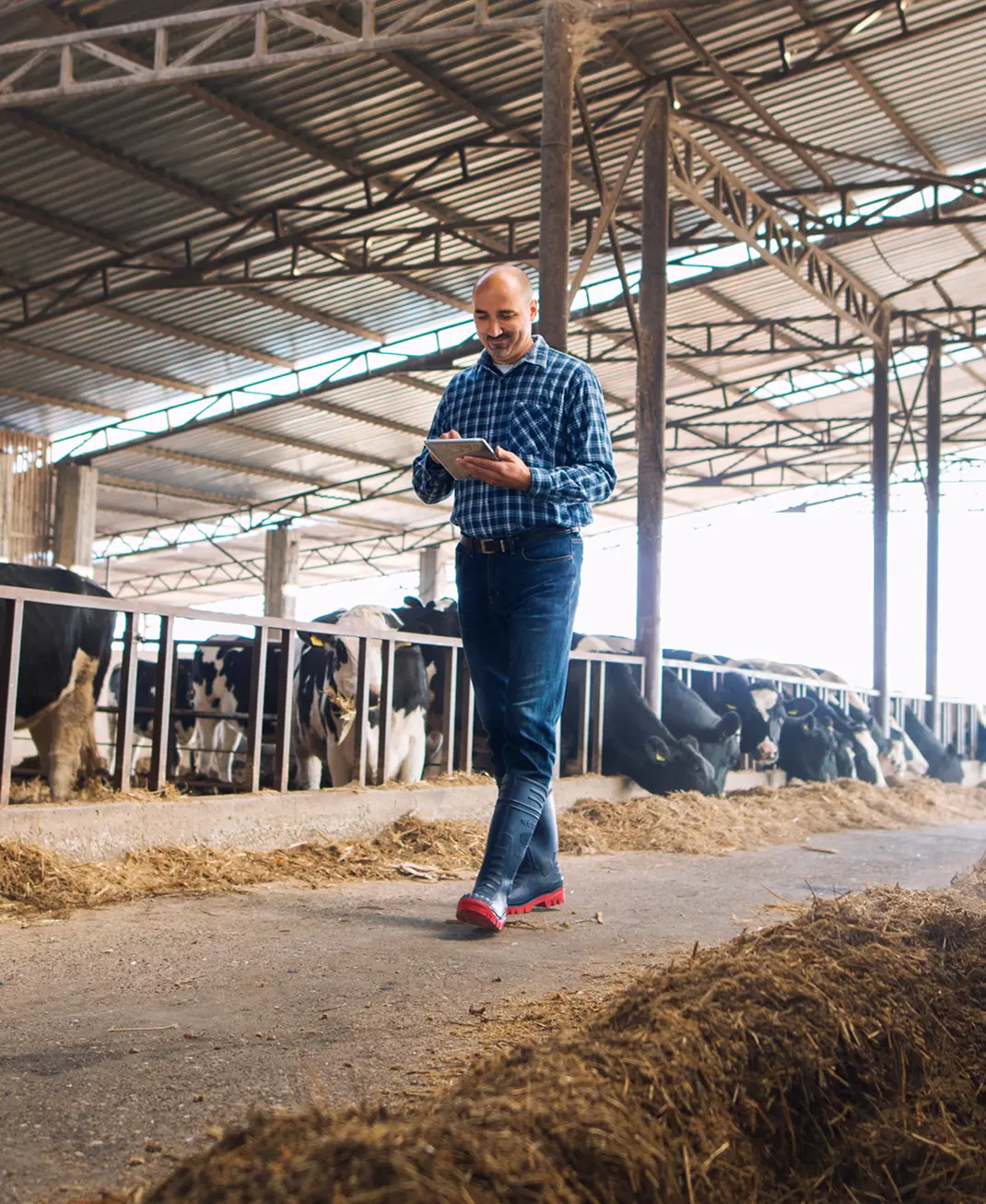
- A daily clinical veterinary examination of the herd should be carried out. Sick animals and those suspected of infectious disease must be identified, isolated, and treated, or a decision should be made regarding their further use, including culling or slaughter for sanitary reasons.
- If animals with suspected infectious disease are identified, or if disease is suspected without an obvious cause, pathological material should be tested in the laboratory to clarify the diagnosis and prevent possible spread of infection.
- Preventive treatment of the herd against endoparasites and ectoparasites should be carried out at least twice a year to prevent parasitic disease and to stop vector-borne transmission within the herd.
- Farm buildings should undergo insect control treatment against insects and their larvae.
- Entry to the farm must be allowed only in protective clothing and footwear. This clothing should be washed and sanitized directly on the farm premises.
- Bird deterrent devices should be installed across the farm to prevent contamination of grain storage areas and cattle buildings.
- Newly purchased animals or animals transferred from other farms must be kept isolated from the rest of the herd for 30 days in a separate building, referred to as an isolation unit, or on a separate outdoor site. This quarantine period is mandatory.
- All types of feed, including finished feed, should be monitored and tested for bacteriological contamination and mycotoxins.
- Să se efectueze monitorizarea furajelor (de toate tipurile), inclusiv a celor finite, și să fie analizate din punct de vedere bacteriologic și pentru prezența micotoxinelor.
- Water used for livestock drinking should undergo laboratory testing at least once a year for pathogenic microorganisms. Its chemical composition should also be checked for toxic impurities and suitability for animal drinking.
- A full planned examination of cattle for leukosis, brucellosis, tuberculosis, and other infections, depending on veterinary status, should be carried out twice a year.
- Biosecurity measures for cattle insemination must be established.
- Biological material taken from cattle, including blood, body fluids, saliva, mucosal swabs, and milk, should be monitored systematically to exclude hidden infections such as subclinical mastitis, viral diarrhoea, infectious rhinotracheitis, parainfluenza-3, respiratory syncytial infection, campylobacteriosis, trichomoniasis, and moraxellosis. This monitoring also supports timely decisions on infection control and elimination.
- Regular in-house laboratory control of farm products should be carried out, including somatic cell counts in milk and laboratory testing of milk for infections.
- Veterinary and sanitary control should be maintained at animal burial sites.
Production buildings must prevent entry by birds and wild animals. Rodent presence should be checked regularly. The all-in all-out principle must be followed in all production facilities.
-
The quality of dairy young stock is assessed using several parameters. These include daily weight gain, ideally 600 g per day for dairy breeds, compliance with breed characteristics, and overall animal health. Promising young stock is defined not only by growth rate, but also by strong constitution and readiness for reproduction at the appropriate age.
Breeding value is assessed through composite indices, along with genotype and development traits.
Selection of replacement young animals for the dairy herd is based on the following criteria: age at sexual maturity, with calving before 24 months considered desirable; fertility, with a 90–95% conception rate during a 60–65-day breeding period; future milk potential based on sire performance and offspring productivity; udder evaluation, including the absence of anatomical defects; and temperament, with calm animals preferred. Growth rate is also assessed, with the optimal target at one year of age being 65% of adult cow body weight. Ease of calving is another important factor and is evaluated using maternal performance records.
-
Preparation of the facility begins with removal of feed and bedding after the animals leave. The first step is mechanical cleaning of manure and dirt from pens, floors, feeders, drinkers, windows, doors, passageways, auxiliary rooms, and the exercise yard. Surfaces are then washed with hot water until their structure and colour become clearly visible. If needed, routine repairs are carried out in the building and on the equipment, after which the floor is washed again.
Disinfection is performed with hot disinfectant solutions in doses recommended by the manufacturer. Premises are disinfected before the start or after the completion of a specific production cycle.
Floor area is determined according to the housing system. Under loose housing on deep bedding in covered buildings, each animal should be allocated 7.5–8 m2for Holsteins and 6 m2 for Jerseys. Bedding usually consists of chopped wood shavings or straw. It should be loosened to a depth of 25 cm twice a day to improve aeration, prevent overheating, and control moisture. Fresh bedding must be added as needed when it starts sticking to the animals or when moisture accumulation becomes visible.
Tie stall housing is used on farms without milking parlours, so animals are fed and milked in the stall. Cattle must receive enough bedding to help prevent mastitis and injuries. Slurry is removed manually from each animal area, while scraper systems are used to remove it from the building.
This system is more common in countries with a cold climate. Its main drawbacks are difficulty detecting heat and a higher number of unsuccessful inseminations. Free stall housing places cows in individual stalls separated by a cleaning area for manure collection and removal. A feed alley runs along the stall rows and must be wide enough for service vehicles. Stall size should ensure animal comfort and sufficient rest. Bedding in individual stalls may include sand, dried manure solids, straw, or other absorbent materials.
Passageways may use slatted floor, which allows manure to pass through into a gravity collection system. Slatted floors can be installed during the planning stage or during building reconstruction. They are made of concrete, and the farm owner selects the manufacturer in advance based on cost, preferences, and the chosen housing technology.
-
The optimal temperature range for dairy cows is 8–15 °C. Recommended air humidity is 40–75%, while air speed should remain within 0.1–1.0 m/s. Cows feel more comfortable in cool conditions than in hot ones, so air exchange should increase when temperature rises.
-
Cows are sensitive to light intensity, and their endocrine system affects productivity. Light intensity above 150 lux for several hours a day can stimulate performance. A range of 150–200 lux is sufficient for resting areas and cow traffic zones. During dark hours, artificial light should not exceed 50 lux. A level of 10 lux or lower is preferable to reduce melatonin suppression.
During daylight hours, light intensity is usually maintained at 200 lux. In milking parlours, the recommended level is 300–500 lux to ensure maximum comfort for both cows and staff.
In cow housing, the light period should generally last 16–18 hours, followed by 6–8 hours of darkness. Extending daylight stimulates prolactin and insulin-like growth factor production, which supports higher milk yield.
Dry cows are usually kept under an 8-hour light period and 16 hours of darkness.
The recommended colour temperature range for lighting is 4000–5000 K, which corresponds to a neutral cool white tone.
-
A lactating cow needs 60–70 litres of water per day to maintain normal body functions, plus 4–5 litres for each litre of milk produced. Water intake depends on animal size, dry matter intake, ambient temperature and humidity, and production level. Animals are watered through individual drinkers or troughs with a drinking space of 75 cm per head. This is important because cows consume 50–60% of their daily water intake after milking, so crowding and competition must be avoided. The water system should provide sufficient pressure, while trough depth should support proper water turnover and prevent stagnation.Drinking water must meet potable water quality standards.When animals are thirsty, appetite declines, feed intake drops, and nutrient utilization worsens. The optimal water temperature is 12–15 °C. To prevent heat stress during hot periods, farms use physical protection methods such as shades, fans, and water spraying, along with functional premixes containing osmoprotectants.
-
Animal management should include preventive treatments and vaccination schedules recommended by veterinary services and adapted to the epizootic situation in the region. If any health problems occur, veterinary advice should be sought without delay.
Our partners and stores in Romania