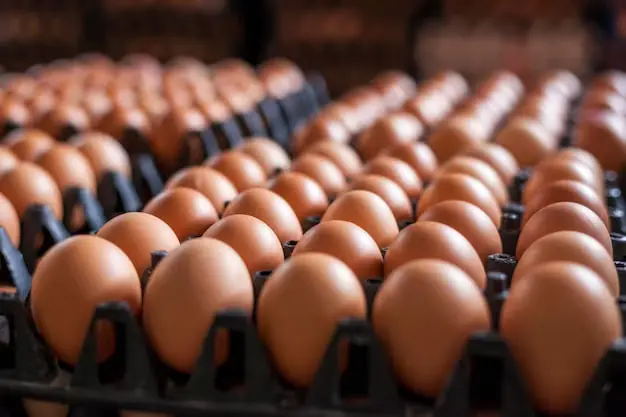
In commercial poultry production, where even a small increase in egg breakage leads to substantial financial losses, eggshell strength is a key indicator of operational efficiency. The shell is first and foremost a protective bioengineered structure that maintains internal integrity, supports embryo development, and prevents microorganism penetration.
YEDNIST’ NUTRITION explains how this structure is formed and which nutritional mechanisms help strengthen it.
Eggshell formation biochemistry
Egg formation takes approximately 24 to 26 hours, with the most critical 19 to 20 hours spent in the uterus, where shell mineralization occurs.
The shell consists of about 96 % calcium carbonate CaCO3. However, its strength depends not only on calcium content but also on the organic matrix. This is a complex protein network, representing around 2 % of shell mass, which serves as a structural framework for calcium crystal deposition.
Key proteins that regulate this process include:
- Ovocleidin (OC-17 and OC-116) supports the development of inner, mammillary, and palisade layers.
- Ovocalyxin-32 (OCX 32) predominates at the final stage and is responsible for the formation of the outer palisade layer and the cuticle, also known as the eggshell surface film.
- Ovocalyxin-36 (OCX 36) is localized in the inner shell area and membranes. It provides protection for the egg and oviduct against pathogen activity.
- Osteopontin (OPN) shows high concentration during the final phase of calcification. It influences CaCO3 crystal size and increases the strength of the outer layer.
- Ovotransferrin, also called conalbumin, is capable of transporting cations and anions. Its primary role involves iron transport. It is present in both the shell and egg white and provides strong antimicrobial activity.
Why does calcium shortage occur in birds at night?
In commercial production, the key limiting factor for strong shell formation is the availability of ionic calcium in the bird’s blood at a precisely defined moment. Eggshell calcification relies on three calcium sources:
- Nutritional calcium provides around 68%
- Temporary bone calcium reserves from medullary tissue contributes about 29 %
- and cortical bone reserves account for roughly 3 %
Peak calcium demand occurs during the night, when birds usually do not feed. As a result, the laying hen is forced to mobilize calcium from bone tissue. Over time, this leads to bone depletion and a decline in eggshell quality.
YEDNIST’ NUTRITION solution: how to improve calcium absorption
The challenge of night time calcium deficiency is not solved by feeding birds during the night, which disrupts physiological rhythms and increases feed conversion. An effective approach lies in the use of calcium supplements, including limestone, with multiple size fractions.
Research data show that:
- fine particles up to 0.09 mm dissolve rapidly and provide an initial calcium peak.
- medium particles around 0.8 mm may remain in the gizzard for up to five hours.
- coarse particles ranging from 1.5 to 2.5 mm dissolve by 40 to 50 % within six hours and ensure a steady calcium supply to the bloodstream during the night, when demand reaches its highest level.
Experts at YEDNIST’ NUTRITION advise maintaining a 75 to 25 proportion between coarse and fine limestone fractions, or adjusting it according to recommendations from genetic suppliers. This approach allows calcium inclusion rates to be modified to each cross and improves overall calcium utilization.
Microelements and vitamins for strong eggshell
Successful calcification requires catalysts that regulate calcium transport and absorption.
Vitamin D3 plays a central supporting role. It is converted into active metabolites that control calcium uptake in the small intestine. With age, the level of these metabolites in the bloodstream declines. Supplementing feed with vitamin D3 significantly enhances calcium absorption and leads to improved shell quality.
Magnesium (Mg) in the form of magnesium oxide also contributes to shell strength and reduces the proportion of damaged eggs.
Zinc (Zn), manganese (Mn), and copper (Cu) function as coenzymes. Zinc is essential for the enzyme responsible for carbonate ion formation. Manganese affects the synthesis of mucopolysaccharides that serve as calcium reserves. Copper participates in the formation of collagen within the organic matrix. The use of manganese, zinc, and copper organic sources produces a more pronounced effect due to higher plasma concentrations of these elements.
YEDNIST’ NUTRITION integrated approach
To achieve maximum results, YEDNIST’ NUTRITION has developed the functional premix INShell. This is a synergistic formula that addresses shell strength through a comprehensive mechanism: INShell – o formulă sinergică ce abordează complex problema rezistenței cojii:
- active metabolite of vitamin D3 together with vitamin C supports optimal calcium absorption.
- magnesium oxide and sodium bicarbonate enhance shell strength and help maintain an alkaline environment.
- chelated zinc, manganese, and copper promote the formation of a high-quality organic matrix.
- sodium butyrate improves gut health, increases nutrient uptake, and further reinforces shell integrity.
The use of INShell stimulates organic matrix formation, raises the level of ionized calcium in the bloodstream, and reduces the negative impact of stress factors. As a result, it ensures high shell quality and extends the period of productive longevity in poultry.